Vehicle recovery made easier
BAGRAM AIRFIELD, AFGHANISTAN—In 2010, soldiers of the 101st Sustainment Brigade teamed up with the Boeing Co. and U.S. Transportation Command to test a new vehicle recovery system that would be fielded in Afghanistan.
The Joint Recovery and Distribution System (JRADS), a flatbed trailer designed to load heavily damaged vehicles and bring them back to base, was tested last year by 14 soldiers assigned to the brigade's Support Operations team during a two-week training session at Fort Campbell, Ky., where the 101st Sustainment Brigade is based.
With the JRADS now in theater, soldiers with the 584th Maintenance Co., 101st Sustainment Brigade, have taken the new and improved trailer through its paces.
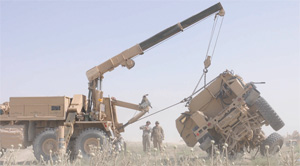
The Joint Recovery and Distribution System is proving successful in vehicle recovery in Afghanistan. Here, soldiers with the 584th Maintenance Co., 142nd Combat Sustainment Support Battalion, 101st Sustainment Brigade, use the JRADS to recover a damaged vehicle. (Photo by Sgt. 1st Class Pete Mayes)
"All the hydraulics work much better than they did back at Campbell," said Sgt. 1st Class Brian Twitty, wheel maintenance supervisor with the company. "On the backside of the trailer, you've got something that allows you to pull something off the side of the trailer at a 90-degree angle."
The "lifeliners" began training on the new system in April 2010, spending two weeks learning the intricacies of the new JRADS equipment. The soldiers, some of them veterans of the Iraq war, had definite ideas on how the equipment could be better fielded in a combat environment.
During the sessions, the team conducted "snatch and pull" training, which consisted of hooking a damaged vehicle to the JRADS and using the winches to pull it onto the flatbed. "It's exactly what it sounds like," said Chief Warrant 2 Dietor Speaks, maintenance technician for the 584th Maintenance Co. "Just hook it up to a trailer, snatch it, and get it out of danger."
Speaks, who will lead the JRADS team missions for his company, was not part of the brigade when the first JRADS training was conducted and is learning the system for the first time. He said he did vehicle recovery back in 2003 while deployed to Iraq.
"Before, all we had was a wrecker. Now, we've got this thing that can pull anything out of anywhere," he said.
The new and improved JRADS can lift vehicles with missing or damaged wheels or axles, as well as overturn and recover vehicles parallel to it. It can also transport vehicles over rough terrain, which is essential in Afghanistan.
Many of the changes that were made to the JRADS dealt with minor issues, such as adding retractable steps to allow soldiers to climb up the trailers.
Gary Noah, JRADS field support representative for Boeing, said his company and the U.S. Transportation Command took to heart the soldiers' suggestions for improving the vehicle.
"We looked at ... their recommendations and added quite a few of them," he said. "The soldier input is invaluable. They're the ones who have to use it every day on mission, so we hold their opinions in high regard."